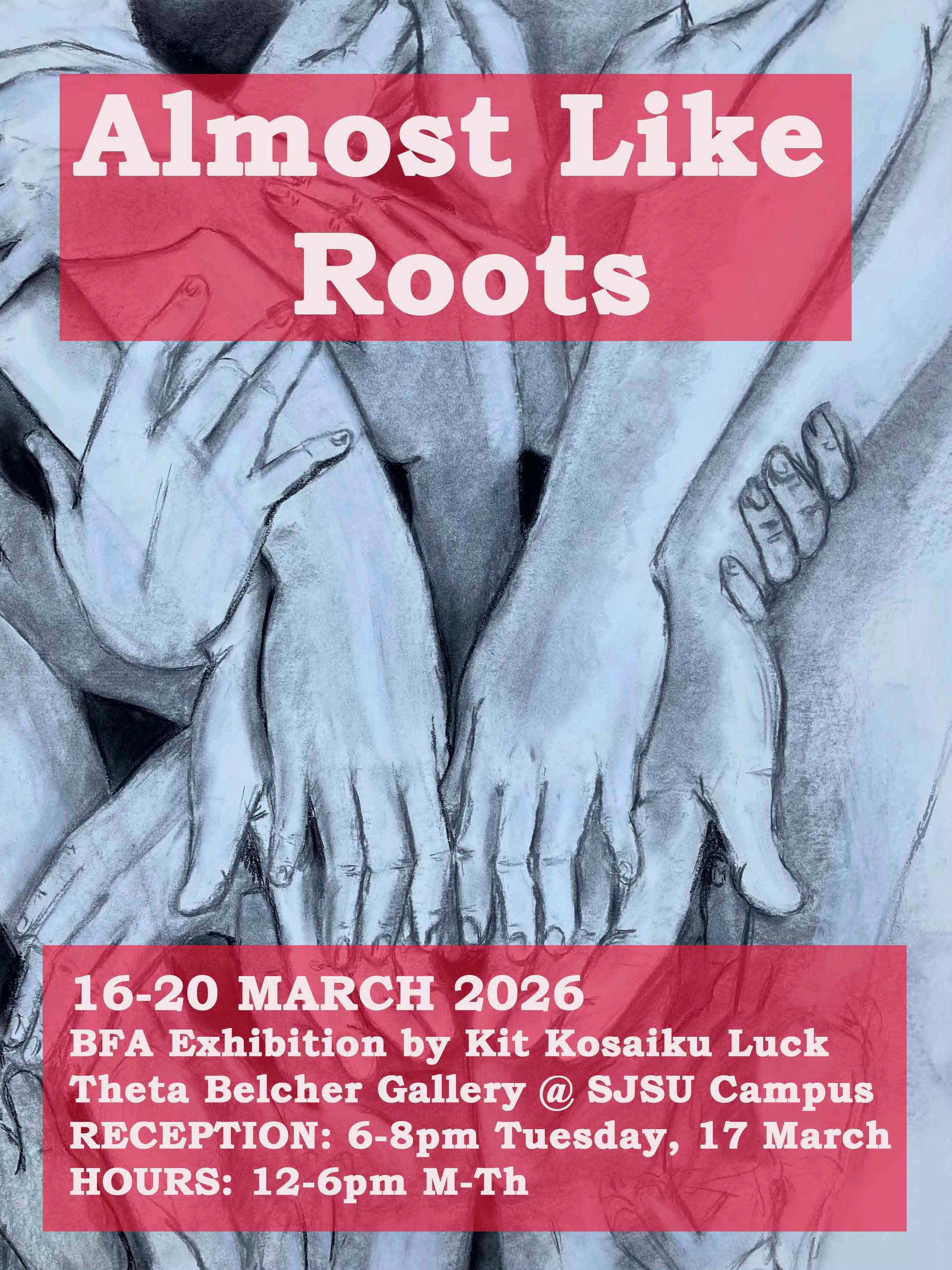
 | Kit Kosaiku Luck: Almost Like RootsTheta Belcher Gallery, 3/16/2026–3/20/2026Advisor: Carla Fisher Schwartz | ||
Artist's Statement
The works in Almost Like Roots started out as an exploration of disconnection, attempting to illustrate the way that I felt very alone in my identity as someone who is both mixed race and trans. What I discovered as I researched the historical crossover between Japan and the United States was that the disconnect was only surface deep; I wasn't alone at all. There were people who looked like me, who lived as a blend of two cultures just like me, for hundreds of years. The cultural crossover itself began even longer ago. There are traces of both of my cultures scattered throughout the art of Japan and the West for as long as they have been interacting and influencing each other: from the Edo woodcut prints that utilize a blend of Japanese floating and European one-point perspective, to Van Gogh attempting to apply ikebana principles to his flower arrangement paintings. While more difficult to pin down thanks to rapidly changing terminology, I learned a lot about gender roles in Edo Japan and the existence of people outside of a binary structure, just like me. Realizing that there, too, I was part of a documented group who existed for more than five hundred years was an indescribable relief.
The media I have chosen to work in and showcase here assist me in the story I am trying to tell. Linocut and screen printing are enormously repetitive, and I found the process of creating multitudes of prints to serve as an excellent metaphor for the ways in which I found the community and connection I wanted the moment I really started looking. My textile work allows me to create spaces that are exactly the dimensions of my body, one part armor and one part turning imagined landscapes into intentionally claiming real space. The building featured in my watercolors is another unreal space, blended architecture from Shinto temples and the 1909 Craftsman house I grew up in. All of the characters are me and not me, straddling a combination of mythologies and time periods.
The most important part of the work included in this show is that creating it has shown me the kind of multimedia artist I want to become. That this struggle I experienced was one my historical precedents also faced: how difficult it is when you, too, are something that belongs to more than one category and is thus never enough of any of them.